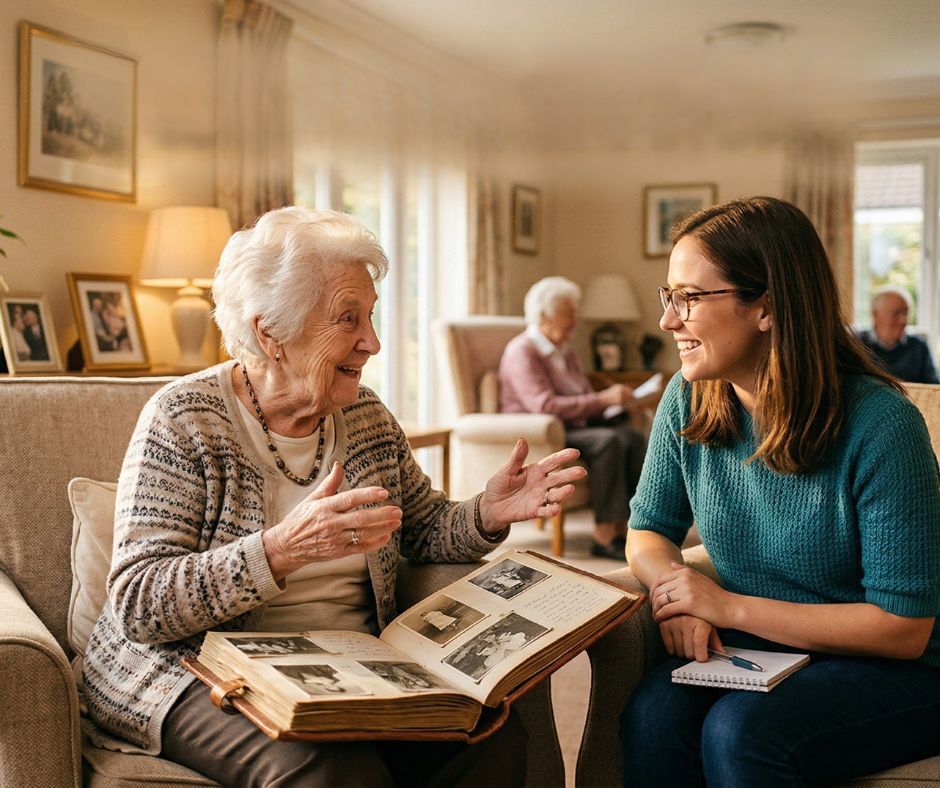
There’s a moment that happens in care settings all the time. Someone who has been quiet, perhaps a little withdrawn, starts talking about the street they grew up on, or the job they had at seventeen, or the dance hall they used to visit on a Friday night. And something changes. Their eyes brighten. Their voice finds its rhythm. They’re not just remembering — they’re alive in that memory.
It turns out, this isn’t just a lovely thing to witness. It’s genuinely good for you.
More Than Just Nostalgia
We often think of reminiscing as a gentle indulgence — a wander down memory lane, pleasant but not particularly purposeful. But research into what’s known as reminiscence therapy tells a different story. Regularly revisiting and sharing personal memories has been shown to improve mood, reduce feelings of depression and loneliness, and strengthen a person’s sense of identity and self-worth.
For older adults especially, life review — the process of looking back and finding meaning in your experiences — is a natural and important part of wellbeing. It’s not dwelling in the past. It’s making sense of a life well lived.
You Are the Expert in the Room
One of the quiet struggles of later life can be a shrinking sense of purpose. Roles change. Routines shift. The things that once defined us — our careers, our parenting, our place in a community — can feel further away.
Telling your life story puts you firmly back in the expert’s chair. Nobody knows what it was like to grow up in your household, to fall in love when you did, to navigate the world through the decades you lived through. Your memories are yours alone, and sharing them is an act of both courage and generosity.
When an older person tells a family member about their childhood, they’re not just passing the time. They’re passing something on.
The Connection It Creates
Families are often surprised by what they learn. Children and grandchildren who thought they knew their loved one well find themselves hearing stories they’d never been told — adventures, hardships, funny moments, quiet acts of bravery. These conversations have a way of deepening relationships in ways that ordinary catch-up visits sometimes don’t.
And for those living with early-stage memory loss, long-term memories are often the most intact. Reminiscing can open a door that other conversations struggle to find. A photograph, a piece of music, a familiar smell — these can unlock warmth and connection even on difficult days.
Simple Ways to Get Started
You don’t need a formal programme or a therapist to make this happen. Here are a few gentle starting points:
Old photographs are perhaps the simplest trigger. Sit together with an album and simply ask: tell me about this one.
Music is extraordinarily powerful. A song from someone’s younger years can transport them instantly. Ask what they were doing when they first heard it.
Objects carry stories too. A piece of jewellery, an old tool, a recipe card in familiar handwriting — each one is a door waiting to be opened.
Writing it down or recording it can turn personal memories into something the whole family treasures. Even a few pages of notes, or a short voice recording, becomes precious over time.
A Story Worth Telling
At Lakeshore Care, we believe that every person in our care carries a lifetime of stories that deserve to be heard. Getting to know those stories — really know them — is part of how we provide care that feels personal, respectful, and warm.
If you’d like to find out more about life at Lakeshore Care, we’d love to welcome you for a visit. Get in touch with our team today.